
Silver FoxEngineering
SYSTEM ARCHITECTURE

Every system needs a clear owner.

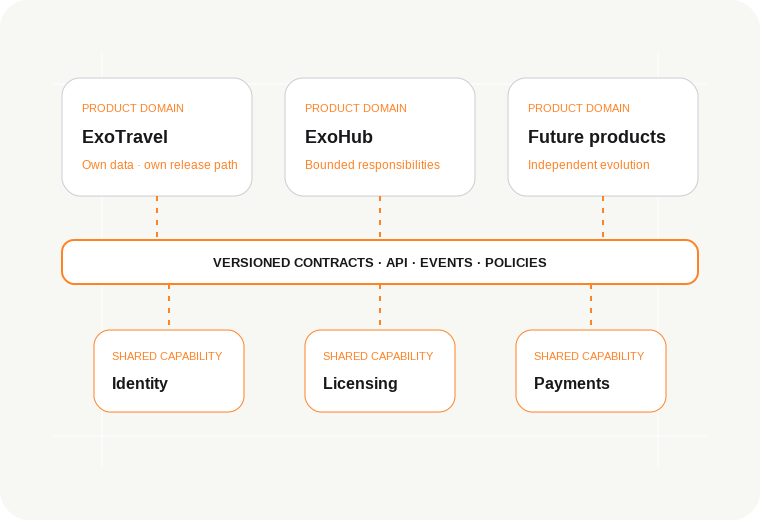
Silver Fox keeps shared technical services separate from each product's business rules. Architecture decides which component owns data, payments, entitlements and release decisions.

These pages document practical boundaries: authoritative state, versioned contracts, tenant isolation and recovery.

SYSTEM VIEW

Ecosystem boundaries

ARCHITECTURE EXPLORERSILVER FOX / PLATFORM
Silver FoxIndependent domains. Explicit contracts.
SELECT A DOMAIN TO INSPECTCONCEPTUAL MODEL
01

Platform and product boundaries

Identity, administration, licensing and payments can become shared platform capabilities without absorbing product-specific workflows. A shared service owns a reusable technical concern; a product domain keeps its business rules and authoritative data.

Shared technical capabilityProduct-owned business behaviorIndependent release paths
02

Data ownership stays explicit

Transactional state belongs to the domain that is responsible for it. PostgreSQL-backed domain data remains authoritative; caches, search projections and analytics views improve access without becoming a second source of truth.

03

Contracts define integration

Versioned APIs and schemas define how independently evolving components meet. The contract is the dependency surface; another service's internal tables, private implementation and deployment model are not.

OpenAPI for synchronous interfacesStable machine-readable errorsCompatibility reviewed as architecture
04

Events decouple progression

Asynchronous integration is used when workflow progression, fan-out or resilience benefits from it. Transactional changes and event intent stay aligned so downstream projections can be rebuilt without inventing business truth.

05

Multi-tenancy crosses every trusted boundary

Tenant context is carried through authorization, data access, background work and operational tooling. Isolation is a system property rather than a filter applied at the interface.

06

Reliability is designed into state transitions

Retries, idempotency, timeout handling, recovery paths and reconciliation are modeled around the business operation. The goal is not to hide failure, but to make uncertain outcomes recoverable and explainable.

07

Security follows ownership and privilege

Identity, authorization, secret handling, audit evidence and least-privilege access are enforced at trusted boundaries. Public documentation explains the principles while sensitive controls and topology stay private.

08

Distribution has to earn its complexity

Components remain modular until scale, isolation, runtime suitability or operational ownership creates a reason to separate them. A more distributed diagram is not automatically a better system.

09

Evolution is a first-class requirement

Backward compatibility, migration paths and versioned boundaries preserve room to change. Architecture is allowed to become more specialized as measured product and operational needs become clearer.

ENGINEERING PRINCIPLE

Good architecture protects options.

A useful architecture is understandable now, measurable in operation and still leaves a credible path to change later.