
01
Ownership before reuse
A capability is shared only when its responsibility and operating owner are explicit. Product domains keep ownership of business rules and authoritative data.
Silver Fox products evolve independently, but independence is bounded by shared rules for ownership, contracts, security, observability and change.
These principles are constraints on how systems are designed and operated. They exist to keep reuse deliberate, coupling visible and operational responsibility clear.
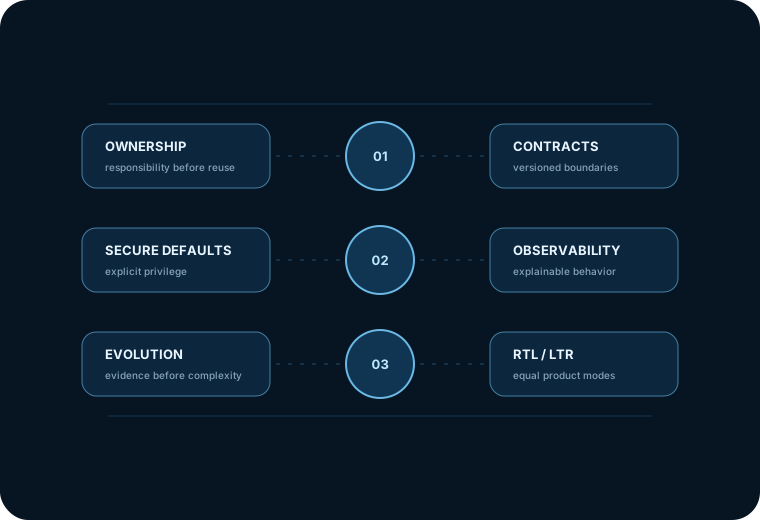
A capability is shared only when its responsibility and operating owner are explicit. Product domains keep ownership of business rules and authoritative data.
Versioned APIs, schemas and compatibility rules define where systems meet. Integration should depend on a contract, not on another component's internal implementation.
Identity, authorization, tenant context, secret handling and audit evidence are designed into trusted boundaries. Privilege is granted deliberately and reviewed as the system changes.
Delivery, telemetry and recovery belong to one feedback loop. A change is not operationally complete until its behavior can be explained with useful signals.
Complexity is introduced when measured scale, reliability or product needs justify it. Components may be split, replaced or centralized as evidence changes.
Localization, typography, direction, accessibility and responsive behavior are first-class product concerns rather than a translation pass at the end.
Shared engineering rules create predictable boundaries so products can move independently without making integration and operations unpredictable.